
Outsourcing parking management costs a management fee plus the operating expenses that run through the budget, and the contract structure you sign decides which of those two numbers you actually control.
Almost nobody asks this question casually. It comes up because the contract is about to auto-renew, because the garage expense line has grown three years running while revenue stayed flat, or because ownership asked what parking is worth and nobody had an answer ready. By the time you are looking it up, you usually have a fee quote from one operator, a very different looking quote from another, and no way to tell which one is cheaper.
The fee is the easiest number to compare and the least useful one. Here is what sits underneath it.
Why the Management Fee Is the Smallest Number in the Conversation
The management fee is the line most owners negotiate hardest, and at a staffed garage it is a small share of what the operation costs to run each year.
Under a management agreement, the fee is the operator's compensation for recruiting, hiring, training, scheduling, supervising, and reporting. Everything else runs through the operating budget: payroll and burden, insurance, supplies, equipment service, card processing. Those expenses are yours, and you reimburse them.
Which is why two proposals can show fees a few thousand dollars apart and still produce very different annual costs. The gap lives in the budget beneath the fee, which is the part nobody reads line by line. The complaint we hear most often is some version of this: the management fee is fine, but the pass-through expenses keep growing.
That gap matters most under cost-plus, where marked-up expenses are the operator's revenue. The structure contains no built-in incentive to reduce the number you are reimbursing. If you are going to negotiate one thing, negotiate the expense side.
The Three Contract Structures, and What Each One Actually Costs
Parking gets contracted three ways, and the structure decides who carries the revenue risk, who keeps the upside, and what the arrangement looks like on your P&L.
Most owners pick the structure after they see pricing, which is backwards. The same garage produces three different looking numbers depending on which structure you ask for.
Management agreement
The operator runs the facility for a fee and you keep the gross revenue. You pay the operating expenses, you set the rates, you own the policy, and you carry the revenue risk. Your cost is the fee plus the budget, and your visibility is total if the reporting is built right.
This is also where the most common objection to outsourcing falls apart. Rate authority, validation policy, and brand standards stay with the owner under a well-drafted management agreement. Losing control of rates is a fear about the document, not a feature of it.
Lease
The operator pays you fixed rent, keeps the revenue, and carries the expenses. Your income becomes predictable, and your visibility disappears along with it. You stop seeing what the facility grosses, and decisions about rates, hours, and service standards now follow the operator's economics rather than yours.
A lease is not free. The cost is the upside you hand over, and it never appears as a line item anywhere. That trade is sharpest in office right now: global office utilization sits at 56 percent (JLL Global Occupancy Planning Benchmark Report, 2026) and average occupancy in major metros is still near 50 percent (CBRE Global Workplace and Occupancy Insights, 2026). Owners rethinking office parking management after a utilization reset usually want exactly the visibility a lease removes.
Revenue share
The operator takes a percentage of revenue, sometimes against a base fee or a guaranteed minimum. The incentive aligns, at least on paper, because the operator earns more when the facility earns more.
The structure only works if you can verify the number the percentage is calculated against. That puts reporting and audit rights at the center of the deal rather than at the back of it, which is a good thing and also the reason revenue share takes longer to paper.
Which structure fits depends on how much revenue risk you want to carry, how much visibility you need, and whether parking is a line you intend to manage or a line you intend to stop thinking about. Decide it at the front of the request for proposal process rather than the end, because it determines what you are asking operators to price.
What Sits Inside the Pass-Through Line
Operating expenses are where most of the money moves, and nearly all of them are predictable enough to budget before you sign anything.
Ask every operator for a line-item operating budget on your template, not theirs. At a staffed garage it should include:
Payroll and burden: wages, payroll taxes, workers' compensation, and the overtime that coverage peaks actually generate
Insurance: general liability, garagekeepers, auto, umbrella, and the COI limits your lender or counsel requires
Revenue control: equipment service contracts, ticket stock, pay station maintenance, card processing fees
Facility items: sweeping, striping, lighting, snow removal, pressure washing, signage
Uniforms, supplies, and deposit or armored car handling
Local supervision: how many hours a week someone above the attendant is physically on site
Two of those surprise people. Card processing is a percentage of revenue, so it scales with success instead of sitting still. And overtime is not a budget overrun. It is the arithmetic of covering shifts in a labor market where call-outs happen.
The facility items need a written boundary between operating and capital. Routine parking facility maintenance handled inside the operating budget is a different conversation from a deck repair or an equipment replacement, and the scope of work should say which side of the line each item falls on before the first invoice arrives.
Revenue control equipment deserves the same treatment. Ask what is installed, what the service contract costs, who pays when a gate arm gets taken out at 2 a.m., and whether your reporting comes out of that system or out of somebody’s spreadsheet. The systems we run get specified as named budget lines rather than assumed into the fee.
What Running Parking In-House Costs When You Load It Fully
The in-house comparison only means something when the internal number carries everything the fee covers, which is almost always more than payroll.
The instinct is to compare a management fee against zero, because in-house parking has no fee. The honest comparison is the fee against a fully loaded internal cost: wages, payroll taxes, workers' compensation, general and garagekeepers liability, recruiting, the cost of turnover, uniforms, supervision, and the share of a salaried manager's week that parking consumes.
That last one is the hardest to price and the easiest to recognize. It is the facility director rewriting a schedule at 6 a.m. because an attendant called out. It is the asset manager fielding a damage claim. It is the property manager deciding whether to tow a resident's car.
That last decision carries real exposure. In residential parking management, enforcement handled by on-site staff puts employees into confrontations they were not trained for, and a towing decision made by an employee or a board member creates legal risk for the association rather than for a third party.
None of this argues that outsourcing is always cheaper. Sometimes it is not. It argues that the comparison most owners run is missing half the numbers on one side of it.

Why Labor Sets the Floor, and Why It Is Market Specific
Labor is the largest line in any parking budget, so the local wage, licensing, and compliance picture sets the floor before any operator quotes a fee.
Start with coverage rather than headcount. A position staffed around the clock is 168 hours a week, which is more than four full time equivalents before you account for vacation, holidays, training, and call-outs. An owner who budgets a 24-hour booth as three people is short, and an operator who bids it as three people is either short too or planning to make it up in overtime.
Then price the position. Valet wages that sat around $12 to $15 an hour have moved to $16 to $20 and above in competitive markets (valet industry trend reporting, 2026). A staffing plan built on last cycle's wage assumption produces exactly the coverage failures you were trying to outsource away.
Coverage cost also tracks the arrival curve rather than the clock. Hospital parking management has to be staffed to shift change and visitor peak, which is when complaints reach administration, and a budget built on an even distribution of demand will not hold.
Valet works the same way. A hotel valet parking operation is priced against arrival and departure volume, event nights, and the brand standard the property is held to, not against a flat hourly count.
Compliance adds a layer that is entirely local. New York City licenses parking lots and garages through the Department of Consumer and Worker Protection, which requires a license at five or more vehicles and lists more than 1,600 licensed facilities. Prevailing wage, union agreements, and permitting vary the same way, which is why a budget for parking management in NYC and the identical scope of work in Pittsburgh produce different numbers for reasons that have nothing to do with the operator.
The Contract Terms That Move the Number More Than the Fee Does
Audit rights, expense caps, capital approval thresholds, and system access determine what the agreement costs across its full term, and they are usually negotiated last or not at all.
Owners negotiate the fee because it is the number they understand, and operators know it. The terms that set your actual cost over a five-year term sit elsewhere in the document:
Audit rights, with a defined scope and a stated answer to who pays for the audit
Expense caps, and the dollar threshold above which you approve a cost before it is incurred
A written definition of capital versus operating, so the boundary is not decided invoice by invoice
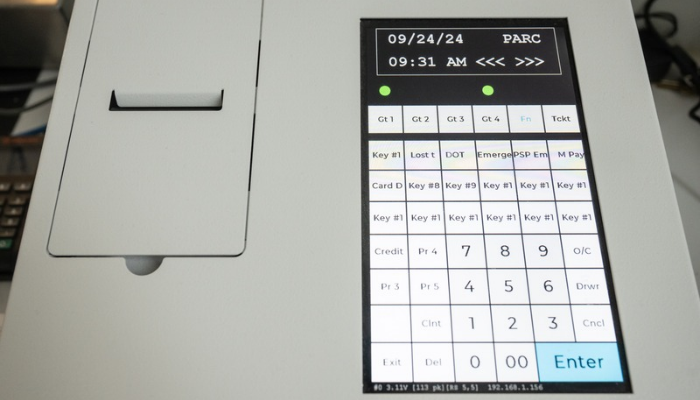
Direct access to the revenue control system and the data behind the settlement report
Performance standards tied to something measurable, and the exit terms if they are missed
Term length and the auto-renewal notice window, calendared the day you sign
Audit rights matter because leakage is designed not to be noticed. An Orange County Comptroller audit reported in 2025 found that a convention center attendant had diverted roughly $57,000 using a personal card reader, discovered only after cameras were installed in the toll booths. In a separate case, auditors found a Miami operator had underreported nearly $900,000. Neither was caught by reading a monthly report.
Automation does not remove the need for this. It relocates it. Manual gate overrides, lost-ticket policy, and grace periods stay exploitable in a cashless facility, which is why the real test is reconciling system revenue against independent vehicle counts rather than trusting the dashboard.
All of it belongs in the document before anyone quotes a price. A parking management RFP that specifies audit rights, expense caps, and reporting format is the only reliable way to get them, because they are far harder to negotiate after the award than before it.
Why Three Proposals Are Rarely Comparable, and How to Fix That
Proposals arrive in three different formats because nothing in the solicitation told the operators to use one, which makes it a specification problem rather than a vendor problem.
The complaint is close to universal. The proposals are not comparable, every operator formats the numbers differently, and the lowest fee is attached to the vaguest staffing plan. That is not coincidence. A proposal written against a loose scope will present itself in whatever light flatters it most.
Specify the format and most of the problem goes away. Require:
A staffing plan by position and shift, with the hourly rate for each position
A line-item operating budget on a template you supply, not one each operator writes
A redacted sample settlement report from a comparable facility
Insurance limits in writing, including garagekeepers, with a sample COI
Three references at properties genuinely like yours, with permission to call them
A written mobilization plan with dates and overlap staffing
Once every proposal sits on the same template, the fee finally becomes comparable, because everything underneath it is. The low bid also stops being mysterious. It is usually low because the staffing plan is short, and a staffing plan that does not hold shows up as coverage failures inside the first two quarters.

What to Do Before You Ask Anyone for a Price
You can build most of the cost picture yourself before any operator quotes you, and doing it first is what makes the quotes mean anything.
Pull 12 months of parking revenue and expense, separated transient versus monthly
Count the coverage you actually need, by position and by shift, including the hours nobody is watching
Build the loaded in-house number, with turnover and supervisory time in it
Decide the contract structure before you ask for pricing
Write the scope so every proposal arrives on the same template
That work takes a few days and it changes every conversation after it. You stop asking what parking management costs and start asking why this operator's number differs from that one's, which is the question that actually has an answer.
If you have been handed the assignment and have never done it before, start with how to bid parking management, which covers the scope, the staffing plan, and the reporting requirements that make proposals comparable in the first place.